
Israel Weapons Industries (IWI) has delivered the first batch of NEGEV 7.62x51 light machine guns to India under the 'Make in India' initiative, marking a significant step in India-Israel defence cooperation and indigenous defence manufacturing.

Iranian President Masoud Pezeshkian delivered a strong address at the UN General Assembly, rejecting US allegations against Iran and accusing Washington and Israel of aggression and terrorism. He criticised US sanctions, defended Iran's peaceful nuclear programme, and highlighted the Palestinian issue.

New photographic evidence and a Pentagon inspector general's report confirm extensive damage to US military installations across the Middle East due to Iranian missile and drone strikes. The report details billions in financial costs, structural losses to hundreds of buildings, and damage to dozens of aircraft, contradicting previous assertions about US military readiness and ordnance stockpiles. The conflict also led to disruptions in the Strait of Hormuz, impacting global oil prices.

A US Air Force colonel, identified by his call sign 'Bravo', survived nearly 50 hours behind Iranian lines after his F-15E fighter jet was shot down near Isfahan. Despite severe injuries, he evaded Iranian forces and was eventually rescued in a complex operation involving US military and intelligence personnel, highlighting a daring mission to leave no man behind.

The Israel Defence Forces (IDF) confirmed the missile launches in a statement on Telegram, noting that defensive systems were actively operating to intercept the threat.

Israel wishes to continue its bombing campaign until Iran's military and industrial infrastructure are degraded to a point where it ceases to pose a threat to Israel. Iran, for its part, has learnt from its experience in the 12-day war of last June. Any ceasefire, it believes, will only be a prelude to another attack on itself. It is determined to convey that any attack on Iran will impose heavy costs on Israel, the US, America's allies in the Gulf -- and on the world at large, points out T T Ram Mohan.

A lesson for India is to clearly define objectives beforehand, so that the adversary or other parties do not attempt to mitigate them midway.

India and Israel on Tuesday signed a defence pact that will facilitate sharing of advanced technologies and promote co-development and co-production of key weapon systems and military hardware, in a major move to further bolster their already robust strategic ties.

'DRDO has been directed to license missile technologies to the private sector.'

The United States, which entered this war in expectation of a short, sharp win along the Venezuela model, is now preparing for deeper involvement in a conflict it does not fully control, without the allies it typically relies on, against an adversary that is not behaving as expected, in a global environment that is already absorbing economic shock. Prem Panicker continues his must read daily blog on the Gulf War.

The Israel Defence Forces (IDF) have conducted a massive military operation targeting more than 200 infrastructure sites within Iran and an additional 140 Hezbollah assets across Lebanon.

It is an unusual choice to depute a retired general for the funeral of a revered religious figure but a thoughtful one in an attempt to inject verve into the bilateral relationship and restore the equilibrium in India's West Asian policies, notes Ambassador M K Bhadrakumar.

16 days into the war, US forces were already running out of ground-attack missiles and Israel is about to expend its entire Arrow interceptor missiles by end March. To be sure, the Iranians are watching closely and that explains their defiant stance that 'Iran will end the war when it decides to do so and when its conditions are met', notes Ambassador M K Bhadrakumar.
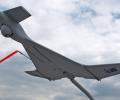
The Israeli-made Harop drone is a powerful weapon that can operate silently in enemy territory and carry a significant payload.

'What we have yet to see on either the US or the Iranian side is willingness to compromise on their ultimate demands and the flexibility to reach an agreement to end the war.

'In such a scenario, Iran could proclaim itself victor, rebuild, re-enforce its diminished regional proxies to further destabilise neighbouring nations and take control of the Persian Gulf and Strait of Hormuz.'

Hegseth said the military campaign, code-named Operation Epic Fury, against Iran is "laser focused" and "decisive," with objectives set directly by the US administration remaining unchanged since the start of operations.

The question is no longer whether the war will expand. It has. The next few days will tell us whether the war stabilises around Hormuz or whether the Strait itself becomes the trigger for a far larger rupture. What to watch for over the next 48 hours is simple: Any move by the US toward direct naval control of the Strait; any credible Iranian attempt to disrupt or mine shipping lanes and, critically, whether energy infrastructure in the Gulf continues to be targeted.If those lines are crossed in tandem, the war will no longer be containable within the region.

'Our diplomacy should have been focused on preventing war and avoiding the inevitable disruptions it would cause, posing a real risk to India's growth story,' asserts former foreign secretary Shyam Saran.

The question is whether the clocks allow enough time for two deeply mistrustful sides to get there, and whether the surface calm holds long enough for the paddling to produce something before the ceasefire ends on April 22, notes Prem Panicker in his must read blog on the Iran War.

'Strikes into the Gulf countries are proof that the security guarantees offered by the US are ineffective and that the Gulf countries cannot rely on American security assurances for their safety.'

AI reduces the time taken to find a target and launch a strike. This has led to a major increase in the pace of the conflict, with one report mentioning nearly 900 strikes launched on Iranian targets in the first 12 hours of an operation.

Israel and the United States had a plan. Iran punched back. And now the Gulf is reeling, the world is beginning to feel the pain and, as on date, no one in Washington or Tel Aviv appears willing to admit that the punch has landed, notes Prem Panicker, continuing his must-read blog on the war in the Middle East.
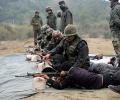
The corner shot weapon will protect members of anti-terror operation parties from coming in line of direct fire from terrorists in close-combat situations, which mostly take place in congested and populated areas of Kashmir, he said.
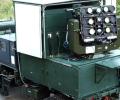
Success has put India in the exclusive and limited club of nations that possess the high-power Laser-DEW.
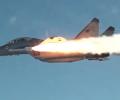
'For weeks, months and years, it would continue to be debated if India should have pushed the early advantage and decapacitated Pakistan militarily.' 'India refused to bite the provocatively proverbial bullet and escalate it into a full-fledged war,' notes N Sathiya Moorthy.

What we are watching is something different: A fog manufactured and maintained by the people who started the war, so that the question of why it was started never has to be answered, observes Prem Panicker in his must read blog on the war in the Middle East.
In days of smart, networked technology and no shame over collateral damage, what will blow up next -- cars, mobile phones, TV sets, refrigerators? And where?, asks Shyam G Menon.

While the final military and intelligence assessment has yet to come, Trump has repeatedly claimed to have "completely and totally obliterated" Tehran's nuclear programme.

A top military official has revealed details about India's proposed air defence system, Sudarshan Chakra, describing it as a comprehensive system that will include counter-drone, counter-UAV, and counter-hypersonic capabilities.

The Israel-Iran conflict has entered a 'decisive phase' after the United States bombed three major Iranian nuclear sites Sunday morning, feel strategic affairs experts with some of them arguing it was Washington, DC's 'responsibility' to not get involved in the military standoff.
An inconclusive end to this war will pose high risk for Netanyahu of a cascading demand for a regime change in Israel, predicts Ambassador M K Bhadrakumar.
'DRDO is working on a number of technologies that will give India Star Wars capability.'

Announcing the launch of "Mission Sudarshan Chakra", Modi said it will be aimed at neutralising enemy threat and enhancing India's offensive capabilities.
Gen Chauhan said a "whole of the nation" approach will be required to develop the shield.
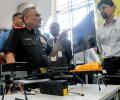
Chief of Defence Staff General Anil Chauhan emphasizes the importance of self-reliance in Unmanned Aerial Vehicles (UAVs) and Counter-Unmanned Aerial Systems (C-UAS) for India, citing recent global conflicts and Operation Sindoor as examples of their strategic importance.
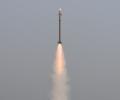
The MRSAM is an advanced path-breaking air and missile defence system that provides ultimate protection against a variety of aerial platforms. Defence experts say that it can shoot down enemy aircraft at a range of 50-70 km.

India has successfully test-fired a long range hypersonic missile from the APJ Abdul Kalam Island off the coast of Odisha, Defence Minister Rajnath Singh said on Sunday.
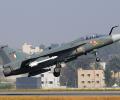
Glimpses from Day 1 at Aero India 2025 at the Yelahanka air base in Bengaluru, India, February 10, 2025.

The report also referred to Prime Minister Narendra Modi's visit to Israel in July 2017.
